A customer recently asked us a question that will sound familiar to many vintage audio enthusiasts:
“Do you have a belt kit for a UHER 4400 Report Monitor tape recorder?”
The answer could have been a simple yes or no.
However, when vintage equipment is involved, the situation is often a little more… flexible.
Original belts are not always available, and replacement kits designed for a specific model may have disappeared from suppliers’ catalogues many years ago.
Fortunately, this does not necessarily mean that your tape recorder, turntable or record player must spend the rest of its life as a particularly attractive decorative object.
Another solution is available: searching for a compatible belt using its dimensions.
Why are vintage audio belts difficult to find?
In the case of the UHER 4400 Report Monitor, we first checked our own stock.
Although we carry a wide range of replacement belts, none of them was specifically listed for this machine.
We then consulted our supplier database. The belts previously listed for the UHER 4400 Report Monitor and the UHER 4400 were also out of stock, whether they were original parts or suitable generic replacements.
This is a common issue with:
Over time, belts may:
The original reference may then become impossible to identify, and a ready-made replacement kit may no longer be available.
No replacement kit? The search is not over
When no belt is specifically listed for the equipment, it may still be possible to find a generic belt with identical or very similar dimensions.
Several characteristics must first be measured.
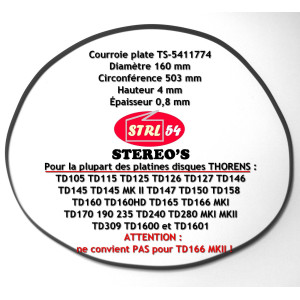
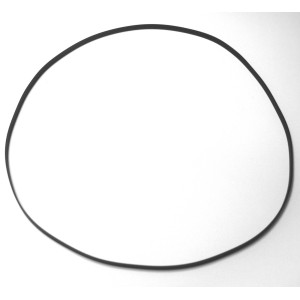
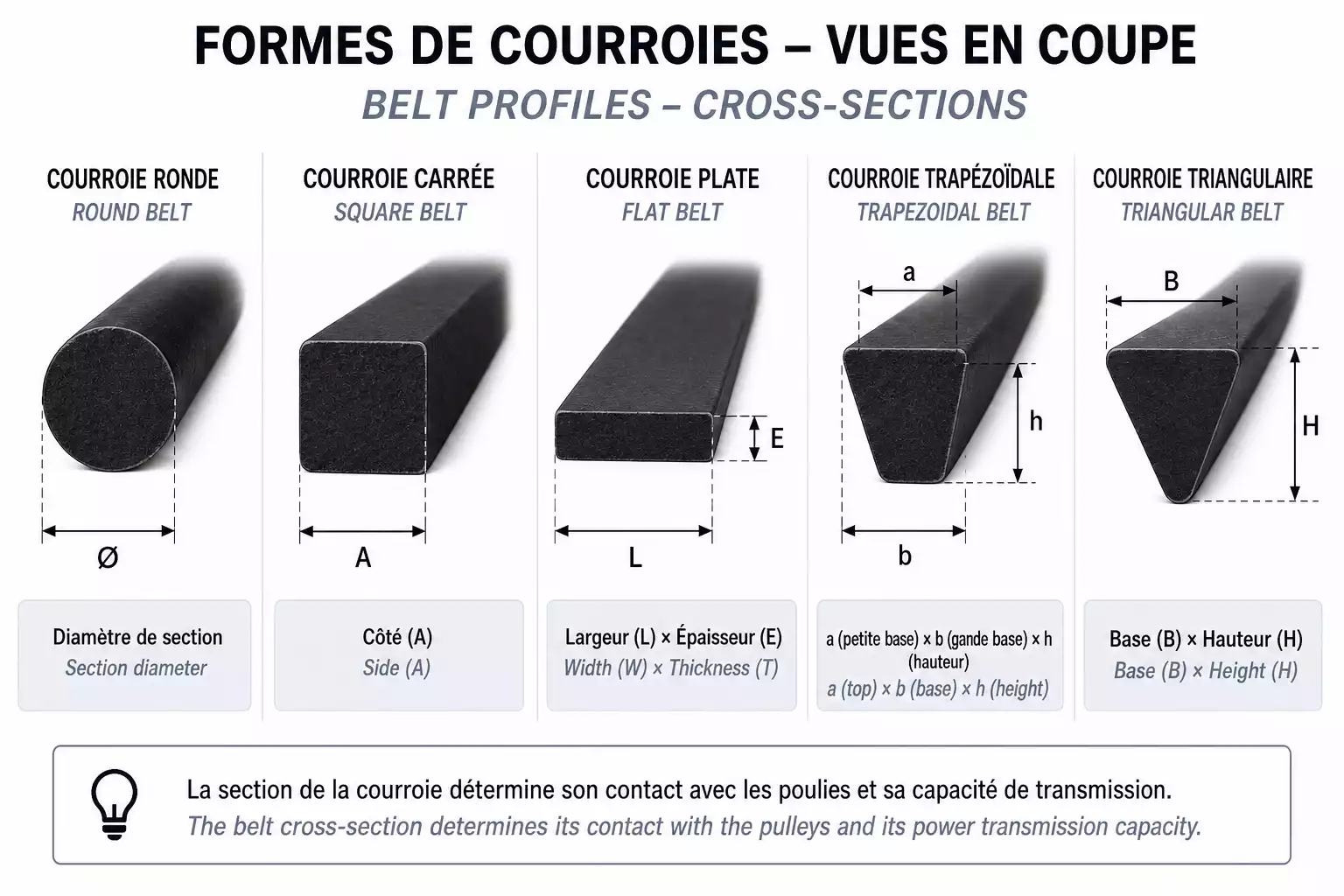
1. Identify the belt profile
Start by identifying the shape of the belt’s cross-section.
A drive belt may be:
This information is essential.
A flat belt generally cannot be replaced by a round belt, even when both have the same overall length.
Vintage audio mechanisms appreciate precision. Improvisation is rarely rewarded.
2. Measure the belt cross-section
Once the profile has been identified, measure the dimensions of its cross-section.
For a round belt
Measure the diameter of the cross-section.
Example:
For a square belt
Measure the width of one side.
Example:
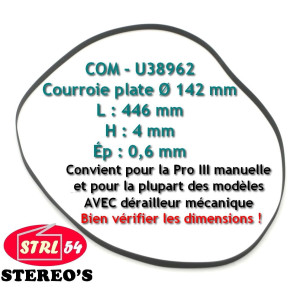
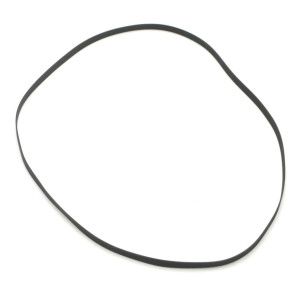
For a flat belt
Measure:
-
its width;
-
its thickness.
Example:
-
width: 4 mm;
-
thickness: 0.7 mm.
A difference that appears insignificant can affect grip, tension and operating speed.
“Close enough” is therefore not always close enough for a tape recorder or turntable.
3. Measure the circumference or internal diameter
You must then determine the belt’s total length, also known as its circumference.
Alternatively, you can measure its internal diameter.
The relationship between these two measurements involves the famous mathematical number Pi, represented by the symbol π, with an approximate value of 3.1416:
Diameter = circumference ÷ π
Conversely:
Circumference = diameter × π
For example, a belt with a circumference of 314.16 mm has a theoretical diameter of:
314.16 ÷ π ≈ 100 mm
This measurement can then be used to search for the closest available references.
Can a stretched belt still be measured?
Yes, although the result must be treated with caution.
An old belt can still provide useful information even when it is:
-
stretched;
-
broken;
-
cut;
-
slightly deformed.
Place it on a flat surface without stretching it and measure its total length.
If the belt is broken, arrange it as straight as possible before measuring.
The result may not correspond exactly to the belt’s original dimensions, as the rubber has probably stretched over time.
However, it still provides a useful starting point for selecting a slightly shorter belt that will provide the correct tension.
A random reduction percentage should not be applied automatically. The required difference may vary according to the belt type, mechanism and condition.
How should a broken belt be measured?
When a belt is broken, place it flat and measure its total length using a ruler or flexible measuring tape.
It is advisable to:
-
avoid pulling or stretching the belt;
-
arrange it as straight as possible;
-
take the measurement several times;
-
use the average of the measurements;
-
measure its width and thickness with callipers.
If the belt has turned into black paste, the process becomes slightly more adventurous.
In that situation, measuring the belt path inside the equipment may be more reliable.
How can you measure the path of a missing belt?
If the original belt has completely disappeared, it may still be possible to measure the path it followed around the pulleys.
You can use:
Place the thread around the pulleys, following the normal route of the belt without pulling it too tightly.
Mark the point where the ends meet, remove the thread and measure its length.
This process requires accuracy and may involve partially dismantling the equipment.
When in doubt, consult an experienced repair technician to avoid damaging the mechanism.
What information is needed to search for a belt?
For a parametric belt search, provide as much of the following information as possible:
-
the equipment brand;
-
the exact model;
-
the equipment type: tape recorder, turntable, record player, cassette deck and so on;
-
the belt profile: round, square, flat or triangular;
-
the diameter or width of its cross-section;
-
its thickness if it is a flat belt;
-
its total circumference;
-
or its internal diameter;
-
the number of belts used in the equipment;
-
photographs of the original belt;
-
photographs of its position and the pulleys.
The more accurate the measurements, the greater the chance of finding a suitable replacement.
A measurement to the nearest tenth of a millimetre is naturally more helpful than “approximately the size of a small bracelet”.
Is a belt with similar dimensions always suitable?
Not necessarily.
A belt with very similar dimensions may work, but several points must be checked:
-
the tension must not be excessive;
-
the belt must not slip;
-
it must remain correctly positioned on the pulleys;
-
the playback speed must remain stable;
-
the mechanism must operate without excessive resistance;
-
the motor must not be subjected to unnecessary strain.
A belt that is too long may slip.
A belt that is too short may place excessive strain on the motor, bearings, shafts and pulleys.
The aim is therefore not simply to find a belt that fits, but to find one that allows the mechanism to operate correctly.
Why is correct belt tension important?
On a turntable, incorrect tension may cause:
On a tape recorder or cassette deck, it may cause:
-
incorrect playback speed;
-
irregular tape movement;
-
fast-forward or rewind problems;
-
slipping;
-
or a mechanism that simply refuses to operate.
A replacement belt is inexpensive compared with the technical or sentimental value of many vintage machines. It still needs to be the right one.
What about the UHER 4400 Report Monitor?
In the case submitted to us, we did not have a kit specifically listed for the UHER 4400 Report Monitor in our own stock.
Our supplier database did not have one available either, whether as an original part or as a generic belt specifically associated with this model.
The most practical solution is therefore to measure the original belts and search for generic references with identical or closely matching dimensions.
Once suitable belts have been identified, their availability, price and home-delivery options can be checked.
Can generic belts save vintage equipment?
Very often, yes.
Many belts used in older equipment were not completely unique to a single model.
A correctly sized generic belt can therefore sometimes replace a reference that is no longer manufactured.
This simply requires a little more research, accurate measurements and, ideally, a pair of callipers.
It may not be as quick as ordering a kit carrying the exact name of your machine, but it can prevent perfectly repairable equipment from being permanently retired.
In summary
The absence of a replacement kit carrying the exact name of your equipment does not necessarily mean that no solution exists.
Five pieces of information are particularly important when searching for a compatible belt:
-
its profile;
-
its cross-section dimensions;
-
its width and thickness if it is flat;
-
its circumference or internal diameter;
-
the exact model of the equipment.
Before sending your tape recorder into permanent retirement or turning your record player into a plant stand, reach for the callipers.
Your vintage machine may not have played its final note yet.
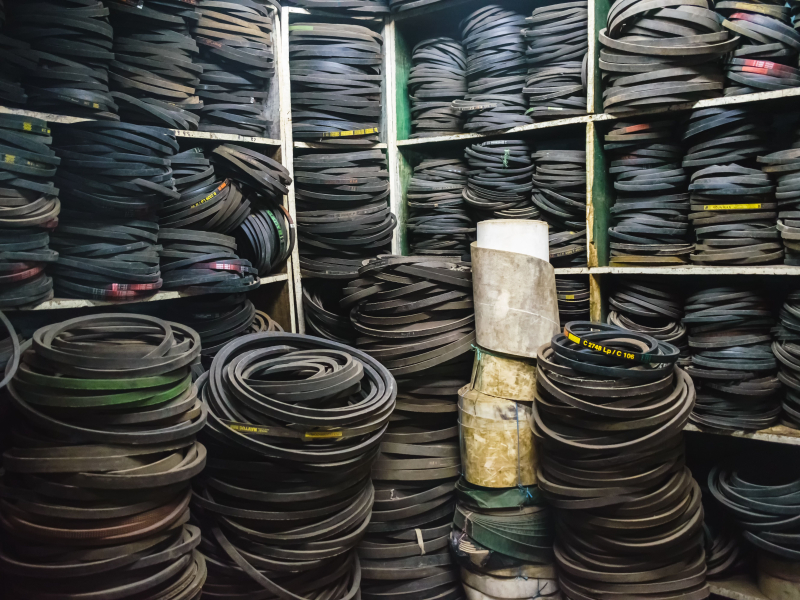
Image by Balaji Srinivasan Thanks!