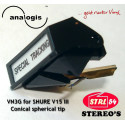
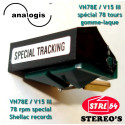
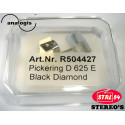
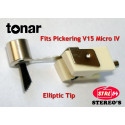
The Shure V15 is one of the most celebrated phono cartridges in the history of vinyl. Originally designed to meet the tracking accuracy and low-distortion demands of professional broadcasters, it became, over the decades, a go-to reference for audiophiles and discerning DJs alike.
But behind that single name, "V15," sits a succession of five cartridge generations, each paired with its own family of replacement styli — and that's where things get complicated. Contrary to what logic would suggest, a stylus reference doesn't always simply mirror the cartridge's name. Get the reference wrong, and you risk damaging your cartridge, or at best, being unable to fit the stylus at all.
Each cartridge generation calls for its own stylus family
The original V15: the naming quirk starts early
Released in the 1960s, the very first Shure V15 uses a stylus called VN2E — not "VN15" as you might expect. It's a very rare reference today, hard to find even on the used market, which makes it a prized piece among collectors.
V15 Type II: still not quite logical
With the V15 Type II, you might think numeric logic has finally kicked in, since the stylus is called VN15 — available in different tip shapes (VN15G spherical, VN15E elliptical, etc.). But that's not quite the case yet: if the pattern that would later take hold (generation number × 10 + 5) had applied from the start, the Type II stylus should have been called VN25 — following the same logic as VN35 for the Type III and VN45 for the Type IV. The name VN15 actually matches the numeric scheme of the very first generation, not the Type II. The generation-based naming logic only truly stabilizes from the Type III onward.
V15 Type III: the cult generation
Likely the best-selling V15 of all time, the Type III equips a huge number of vintage turntables still in use today. Its stylus changes name again, becoming VN35, with several tip variants: VN35E (elliptical), VN35HE (hyperelliptical), and so on.
V15 Type IV: the arrival of micro-ridge
The fourth generation introduces VN45 styli (VN45E, VN45HE, VN45MR...). The "MR" stands for micro-ridge, a tip-grinding shape invented by Shure (the term is presumably trademarked), defined by a fine "micro-ridge" contact edge along the groove. Later, a manufacturer like JICO appears to have drawn inspiration from it — intentionally or not — with its own SAS (Super Analog Stylus) shape, whose profile echoes the original micro-ridge.
V15 Type V: two generations, two incompatible standards
This is where caution becomes essential. Styli for the V15 Type V are called VN5. But for the final evolution of the line, the V15 Type V xMR, they become VN5 x...
⚠ Critical compatibility note
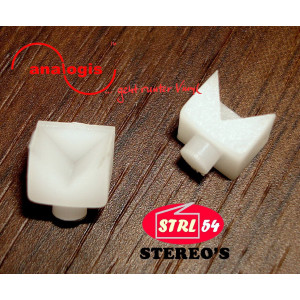
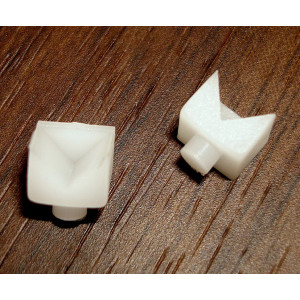
That small "x" is not a cosmetic detail. The root cause is mechanical: the shank — the brass rod (or rail) that houses the tiny mobile magnet inside the stylus — is wider, and likely longer, on the "x" versions. An "x"-type stylus (like the VN5 xMR) therefore can't physically fit into the engagement bore of a standard V15 Type V cartridge; conversely, a standard stylus would sit loosely ("swim") inside an "x" cartridge's bore, without the snug fit needed for proper coupling.
But mechanics alone don't explain it: the internal construction also differs between the two generations — coil placement, electromagnetic characteristics, and above all the invisible-but-real alignment between the mobile magnet and the internal coils. Somewhat like an electric guitar, where the vibrating string needs to sit directly opposite the pickup poles to capture the signal properly — except here it's the magnet itself that moves and sits surrounded by fixed coils, rather than the other way around. This is, in fact, the same principle behind certain Pickering "moving iron" cartridges, which are still classified as MM (moving magnet) and are preamplified through a standard MM phono input, not MC. The upshot: even if you forced a mechanically possible fit, a stylus that isn't electromagnetically matched would degrade playback performance.
Reference chart — Shure V15 cartridges & styli
Generation
Stylus reference
Sample variants
Notable detail
V15 (original)
VN2E
—
Name unrelated to "V15"; very rare
V15 Type II
VN15
VN15G, VN15E
Numeric logic not yet stable
V15 Type III
VN35
VN35E, VN35HE
Best-selling version
V15 Type IV
VN45
VN45E, VN45HE, VN45MR
Micro-ridge (MR) introduced
V15 Type V
VN5
VN5E, VN5HE
—
V15 Type V xMR
VN5 x…
VN5 xMR
Not compatible with standard V
The replica trap: watch out for a misleading "MR"
One last point deserves close attention, especially if you're buying a replacement stylus from a third-party manufacturer (Tonar, JICO, etc.): the term MR or xMR is often kept in the product name, even when the stylus is not actually a micro-ridge.
⚠ Check before you buy
In practice, this term is mostly used as a search and cataloguing marker — the replacement stylus's actual tip shape could well be elliptical, hyperelliptical, Shibata, or SAS. The "MR"/"xMR" in the name mainly flags compatibility with the right cartridge generation, not necessarily the tip-grinding shape itself.
One more nuance worth digging into: it's possible that some "standard" V15 Type V units (before the xMR version existed) were, at some point in production, factory-fitted with a genuine micro-ridge stylus — which is suggested, for instance, by this JICO reference, labelled "MR" and explicitly intended for the standard V15 V (not the xMR version). Conversely, searching for "V15 V xMR" replacement styli surfaces several distinct options — including a Tonar model — explicitly built for that variant, confirming the two ranges are indeed kept separate across third-party catalogues. This remains to be confirmed against Shure's own catalogues and archives (including discontinued product sheets), but it reinforces a simple principle: it's always safer to check the exact reference marked on your cartridge than to rely solely on its commercial name or assumed generation.
In short
Before ordering a replacement stylus for your Shure V15, pin down exactly which cartridge generation you own (I through V, with or without the "x"), and don't rely solely on the stylus's commercial name — always double-check mechanical compatibility with your exact model.
Looking for the right replacement stylus for your Shure V15?