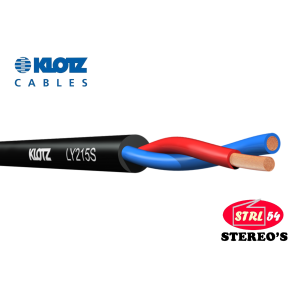
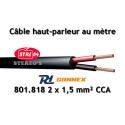
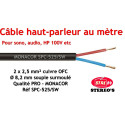
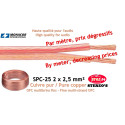
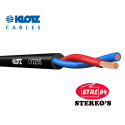
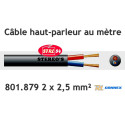
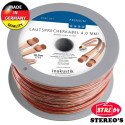
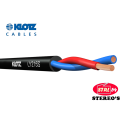
There is a very simple way to turn a peaceful discussion between hi-fi enthusiasts into an endless debate: say the words “speaker cable”.
Within minutes, someone will explain that an expensive cable “opened up the soundstage”, someone else will recommend ordinary electrical wire from a DIY store, and a third person will bring up the famous story of a wire coat hanger that supposedly matched an audiophile cable in a blind listening test.
This well-known coat-hanger experiment, widely shared online, is more anecdote than scientific protocol. It nevertheless perfectly illustrates the atmosphere surrounding the subject: accusations of snake oil, reports of miraculous listening experiences and discussions that can become slightly… electric.
As is often the case, reality lies in a much less spectacular middle ground: there is no need to sell a kidney to connect an amplifier to a pair of speakers, but there is no point being so stingy that you use an undersized cable made from an unidentified material.
Let us look at what really matters.
↑ Back to top
What does a speaker cable do?
A speaker cable carries the electrical signal supplied by the amplifier to the loudspeakers.
It does not create extra detail, add dynamics or recover notes that disappeared during the recording. Its main purpose is to transmit the signal while introducing as little loss and alteration as possible.
A real cable has several electrical characteristics:
- resistance;
- inductance;
- capacitance.
Capacitance is the electrical capacity of the capacitor formed between the cable’s conductors, distributed along its entire length.
This “parasitic” capacitance, generally expressed in picofarads per metre, may attenuate high frequencies. Its influence becomes more significant as the impedance of the connection increases.
It is usually negligible with short speaker-cable runs because this is a very low-impedance connection, for example 8 ohms. It can have a much greater influence on higher-impedance connections, such as a guitar or instrument connected to an amplifier, a turntable connected to a phono input, or even a microphone connected to a mixing desk over a long distance, even when the impedance remains in the range of a few hundred ohms.
Serious manufacturers publish these values. Belden, for example, lists conductor resistance, capacitance between conductors and inductance per metre for some of its stranded-copper audio cables.
These are measurable figures and are far more useful than promises of “holographic presence” or a “blacker background”.
In a typical domestic installation using reasonable cable lengths, resistance is generally the first parameter to watch. It mainly depends on three factors:
- the conductor material;
- the cable cross-sectional area;
- the cable length.
The longer and thinner a cable is, the higher its electrical resistance becomes.
This is especially important when connecting speakers to an amplifier because the impedance, meaning the complex resistance of the load, is very low, usually only a few ohms. At the same time, the transmitted power is relatively high and can involve a current of several amperes.
↑ Back to top
Why is copper used?
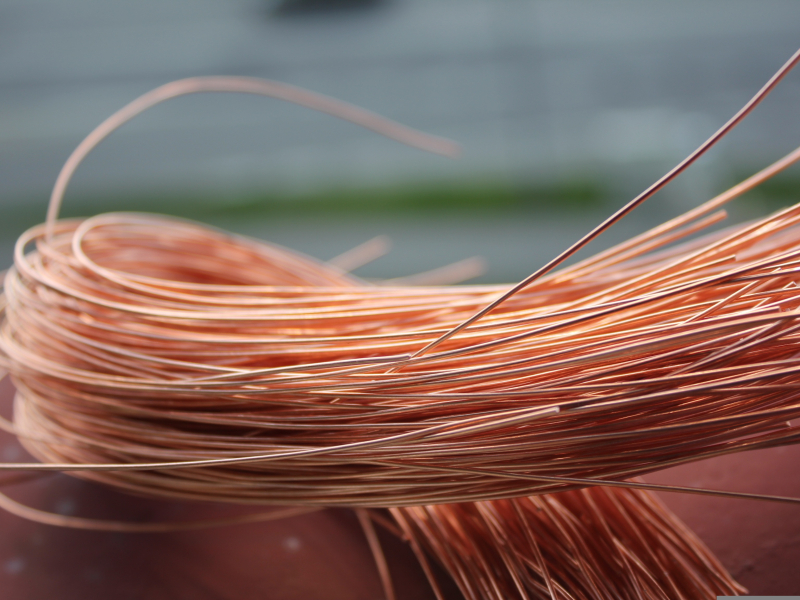
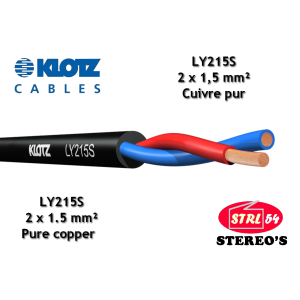
Copper offers excellent electrical conductivity while remaining relatively easy to work with, draw into wire, solder and connect.
Its conductivity is often expressed as a percentage of IACS, the International Annealed Copper Standard. The reference value for annealed copper is 100% IACS. Modern manufacturing processes even allow some commercial copper grades to slightly exceed this value.
However, the clearest way to express and reflect its conductivity is the value known as resistivity, expressed in ohm-metres.
The resistivity of copper at 20°C for a cross-sectional area of 1 mm² is 0.01724 Ω × m.
Among commonly used metals, copper is the best electrical conductor after silver, with relatively little difference between the two.
For a 2 mm² conductor instead of a 1 mm² conductor, the resulting resistance is halved. It is halved again with a 4 mm² cable. This is why choosing a sufficiently large cross-sectional area becomes increasingly important as cable length increases.
For example, for a 10-metre speaker-cable run, a 4 mm² cross-section, meaning a 2 × 4 mm² cable, is much more advisable than a cross-section of only 1 mm².
This explains why copper has become the reference material for speaker cables: it combines low losses, good availability and a still-reasonable cost.
Copper is therefore not chosen because it is supposedly “more musical”. It is chosen because it conducts electricity very well.
That may be less poetic, but it is much easier to measure.
↑ Back to top
Pure copper and OFC copper: a real difference, but no magic
The marking OFC, meaning Oxygen-Free Copper, refers to copper with a very low oxygen content.
This is not simply a marketing term. Standardised copper grades genuinely exist:
- C11000 copper, commonly used for electrical applications, contains at least 99.90% copper and has a minimum conductivity of 100% IACS;
- C10200 oxygen-free copper contains at least 99.95% copper, with a maximum oxygen content of 0.001%, and also reaches at least 100% IACS;
- C10100 oxygen-free electronic copper contains at least 99.99% copper and reaches 101% IACS.
In other words, OFC is indeed high-purity copper, but the difference in conductivity compared with good-quality electrical copper is extremely small.
And that really is true, as the famous French TV character Mère Denis used to say!
This does not mean that OFC cable is useless. The marking is generally a useful indication of the conductor material.
However, it is not enough to guarantee that a cable will sound better. The real cross-sectional area, resistance, length and manufacturing quality remain far more important than a simple logo printed on the insulation.
A 1 mm² OFC cable does not suddenly become better than a good 2.5 mm² copper cable simply because its packaging contains more letters.
↑ Back to top
CCA: copper on the outside, aluminium on the inside
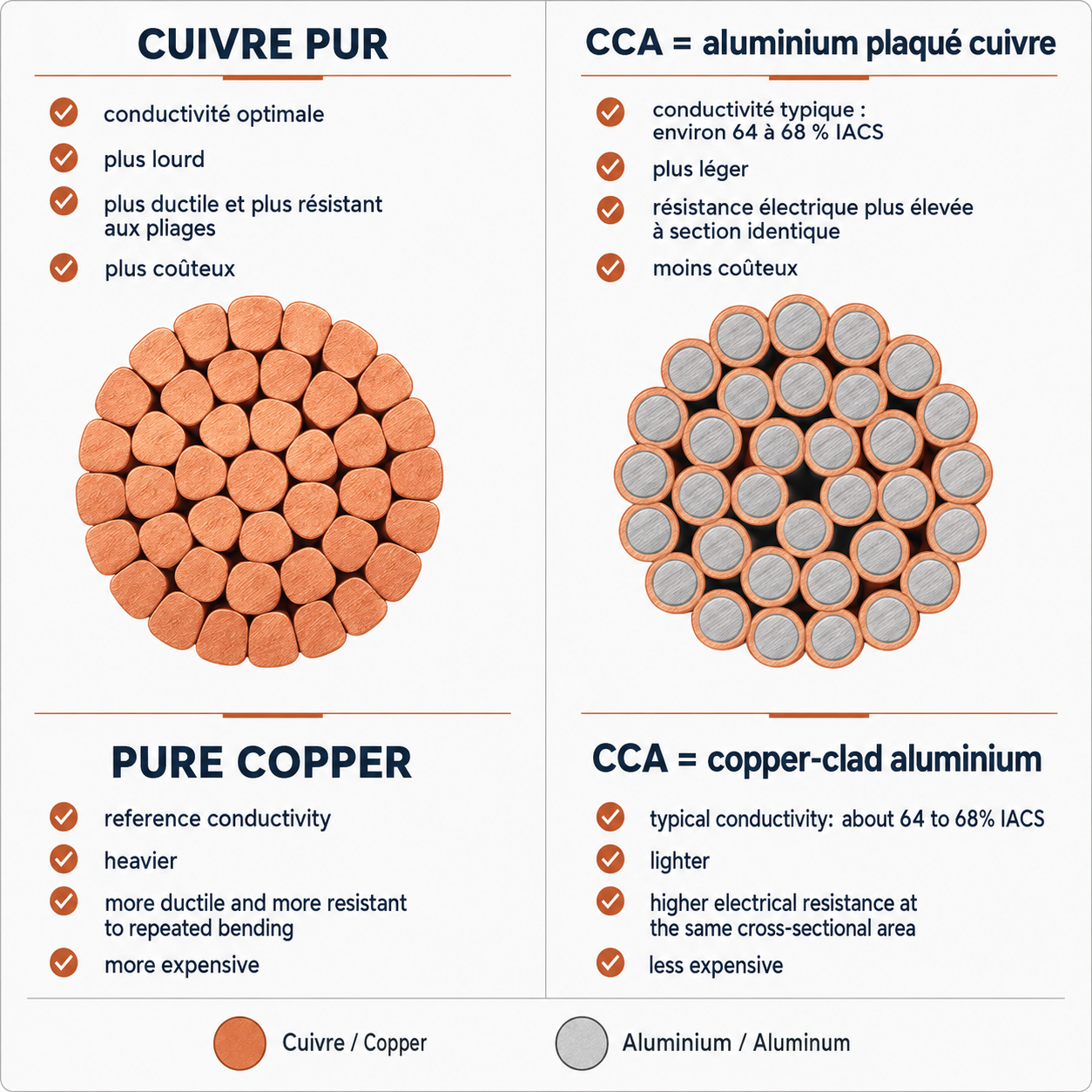
CCA stands for Copper-Clad Aluminium.
Despite its copper colour, a CCA conductor is not made entirely from copper. It consists of:
- an aluminium core;
- a thin outer layer of copper bonded to that core.
CCA is not necessarily a fraudulent product. There is even a specific ASTM standard covering conductors containing, among other configurations, 10% or 15% copper by volume.
The problem arises when this material is sold as pure copper or when its actual cross-sectional area and resistance are not clearly stated.
↑ Back to top
Does CCA conduct only half as well as copper?
It is sometimes claimed that CCA always provides “50% of the conductivity of copper”.
That is too simplistic.
Conductivity depends on the proportion of copper, the aluminium alloy and the way the conductor is manufactured. One CCA wire manufacturer, for example, gives the following figures:
- 100% IACS for copper;
- around 68% IACS for CCA containing 15% copper;
- around 62% IACS for the aluminium used in its comparison.
With a conductivity of 68% IACS, a CCA cable has approximately 47% more resistance than a copper cable of the same cross-sectional area.
To obtain approximately the same resistance as a 2.5 mm² copper cable, you would therefore need close to:
2.5 ÷ 0.68 = 3.7 mm² of CCA
This explains why a large CCA cable can work correctly, while a small CCA cable used over a long distance quickly becomes less attractive.
↑ Back to top
Why is CCA sold?
CCA has two obvious advantages:
- it is lighter;
- it is cheaper than copper.
In return, its electrical resistance is higher. More material is therefore required to achieve performance equivalent to that of a copper cable.
CCA may be suitable for some budget installations when it is correctly sized.
For a durable hi-fi installation, however, copper remains the simpler choice: it allows a smaller cross-sectional area, offers more safety margin and avoids uncertainty about the conductor material.
↑ Back to top
A cable’s cross-sectional area is expressed in square millimetres. It represents the amount of conductive metal available to carry current.
The resistance of a cable can be estimated using the formula:
R = ρ(L/S)
Where:
- R is the resistance of the connection;
- ρ is the resistivity of the material;
- L is the distance between the amplifier and the speaker;
- S is the cross-sectional area of the conductor.
The factor of 2 accounts for both the outward and return conductors.
For copper, using a resistivity of approximately 0.01724 Ω·mm²/m at 20°C, the following figures provide useful reference points:
| Distance to the speaker |
Copper cross-section |
Approximate total loop resistance |
| 3 metres |
1.5 mm² |
0.069 Ω |
| 10 metres |
2.5 mm² |
0.138 Ω |
| 20 metres |
4 mm² |
0.172 Ω |
These values provide a few simple guidelines for a domestic installation:
- up to around 3 metres, 1.5 mm² may be sufficient;
- between 3 and 10 metres, 2.5 mm² is an excellent all-round choice;
- beyond 10 metres, with 4-ohm speakers or high power, 4 mm² provides additional safety margin.
These are not absolute limits. One speaker may present a more demanding load than another, and installation conditions can vary.
However, these cross-sectional areas generally avoid unnecessary losses without becoming excessive.
In summary, it is better to invest in a genuine 2.5 mm² copper cable than in a very thin cable advertised as having undergone a mysterious molecular treatment.
↑ Back to top
Stranded or solid conductor?
Domestic speaker cables are generally made from many small strands of copper.
The main advantage of a stranded conductor is mechanical: it makes the cable more flexible, easier to install and less sensitive to repeated bending.
Professional cables also commonly use bare stranded-copper conductors.
However, one common misunderstanding should be avoided: an ordinary stranded cable is not automatically a Litz-wire cable.
In genuine Litz wire, each strand is individually insulated and arranged in a precise geometry to reduce certain high-frequency effects.
In an ordinary speaker cable, the strands are in electrical contact with one another. Their main purpose is therefore to improve cable flexibility.
↑ Back to top
What about skin effect?
Skin effect is the tendency of alternating current to flow increasingly near the surface of a conductor as frequency rises.
The phenomenon is real. However, its importance at audio frequencies is often greatly exaggerated in marketing claims.
Belden considers that at 20 kHz, the upper end of the audible frequency range, the effect remains very small for the wire sizes commonly used in audio.
The manufacturer concludes that it is barely measurable across this frequency range and should not be confused with the effects encountered at radio frequencies or in video cables.
Skin effect is therefore not imaginary, but it does not by itself justify a domestic cable costing as much as an amplifier.
Despite its name, it also requires neither moisturiser nor a visit to a dermatologist.
↑ Back to top
Should you buy the cheapest possible cable?
No.
A good speaker cable should provide:
- conductors clearly identified as copper;
- a cross-sectional area suited to the cable length;
- resistance consistent with that cross-sectional area;
- insulation that is both sufficiently robust and flexible;
- clear identification of the two conductors;
- consistent manufacturing quality.
The connections also deserve attention.
An oxidised or poorly tightened conductor, or a terminal with loose strands protruding from it, can cause more trouble than a microscopic difference between two grades of copper.
Banana plugs are not essential. They are mainly convenient when cables are connected and disconnected regularly.
A properly stripped cable, carefully prepared and firmly clamped in a suitable binding post works perfectly well.
↑ Back to top
So, how much should you spend?
There is no magic percentage of the system’s price that should be spent on cables.
The sensible approach is to buy a product that is:
- properly constructed;
- clearly documented;
- made from genuine copper;
- large enough for the required length;
- free from expensive and unverifiable promises.
There is no need to buy a cable matured in an oak barrel, cryogenically treated under a full moon and aligned with the direction in which the electrons supposedly travel.
However, connecting demanding speakers to a powerful amplifier with fifteen metres of 0.75 mm² CCA simply because “wire is wire” is the opposite extreme.
Between the two lies a far less spectacular but generally excellent solution: a good 2.5 or 4 mm² copper cable chosen according to the required length.
↑ Back to top
Conclusion: the right compromise without spending a fortune
A serious speaker cable will not transform a hi-fi system. It will simply allow the system to work without being unnecessarily penalised.
The essential criteria are ultimately quite simple:
genuine copper, sufficient cross-sectional area, a reasonable length and clean connections.
OFC copper is a perfectly valid choice, but the name should not make us forget that cross-sectional area and resistance remain the main priorities.
CCA can work when it is honestly labelled and correctly sized, but it requires a larger cross-sectional area to match the electrical performance of copper.
There is therefore no need to choose between bell wire and an esoteric cable delivered in a mahogany presentation case.
As is often the case in hi-fi, the best solution is not to be gullible… without being stingy either.
↑ Back to top
Image by Daniela Mackova from Pixabay