The holiday season is often when turntables come back down from the attic or out of a parent’s living room. The motor still spins, the belt still holds, but the sound crackles, hisses on “s” sounds or skips across grooves. Most of the time the culprit is tiny: the stylus.
The good news: on most turntables, replacing it takes no tools and no trip to a repair shop. The main thing is to find the right part, then make three calm movements. Here is the method, step by step.
Stylus, needle, cartridge: what you actually replace
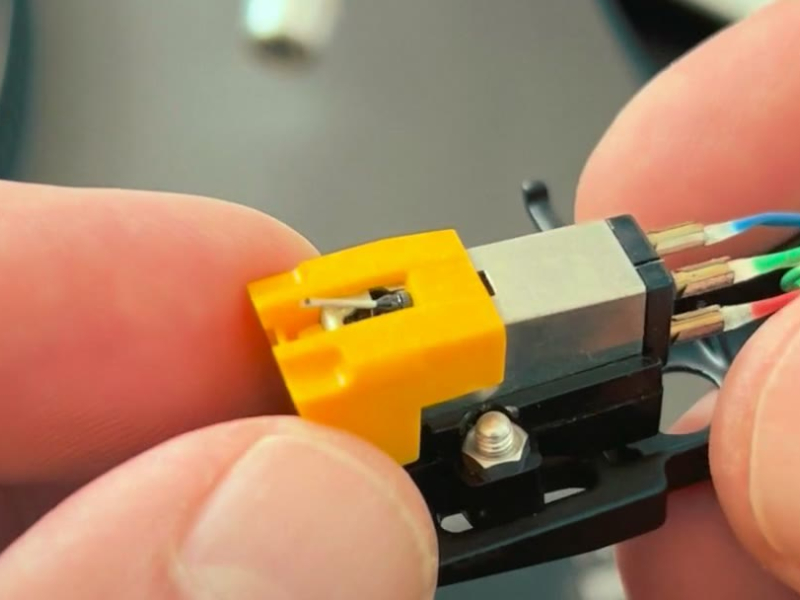
The diamond tip reads the groove. It sits at the end of a thin rod, the cantilever, held in a small plastic block: the whole assembly is the stylus (or “needle”). The stylus plugs into the cartridge, the small body screwed under the headshell, which turns vibrations into an electrical signal.
So “changing the needle” really means replacing the complete stylus. The cartridge stays in place: no wires to unplug, no alignment to redo.
Step 1: identify your cartridge
The stylus depends on the cartridge, not on the turntable. Two turntables from the same brand can use different cartridges, and one cartridge may be fitted to dozens of turntables.
Where to find the reference?
- On the side or front of the cartridge: brand and model are often engraved or printed (for example “Shure M95ED” or “AT3600L”).
- On the front of the stylus itself, if the cartridge is hard to read: it shows the stylus reference (for example “N95ED”).
- In the manual or under the turntable, which sometimes lists the original cartridge.
Note: the stylus reference is not the cartridge reference. Manufacturers often use a different prefix:
| Cartridge |
Replacement stylus |
| Audio-Technica AT3600L |
ATN3600L |
| Audio-Technica AT-VM95E |
ATN-VM95E |
| Shure M75ED |
N75ED |
| Shure M95ED |
N95ED |
| Ortofon OM 10 |
Ortofon Stylus 10 |
| Ortofon 2M Red |
Ortofon Stylus 2M Red |
With Shure in particular, suffixes and generations matter: see our article on Shure V15 styli.
No readable reference? Type your turntable model into the site search: our product pages list compatible models. Otherwise, send us a photo of the cartridge from the front and side, with the turntable’s brand and model. We will find the equivalent in our suppliers’ catalogues.
Step 2: check that the stylus is replaceable
The vast majority of consumer turntables use a moving magnet (MM) or ceramic cartridge with a removable stylus. Three cases are worth a word:
- Moving coil (MC) cartridges, more high-end (for example the Denon DL-103): the stylus cannot be removed. You replace the whole cartridge, or have it repaired by a specialist.
- P-mount (T4P) cartridges, common on 1980s automatic turntables: the cartridge is held by a single screw and the tracking force is set by the turntable. The stylus is changed as on a standard cartridge, and there is nothing to adjust afterwards.
- Ceramic cartridges with a flip-over stylus, on some record players: a small knob turns the tip between a 33/45 rpm side and a 78 rpm side. The stylus usually pulls out forwards, but check which side must be in playing position.
Step 3: remove the old stylus
Before touching anything:
- Switch the turntable off and put the arm on its rest, locked if possible.
- Fit the stylus guard if there is one, or hold a small piece of card over the tip.
- Work in good light, without rushing.
Then hold the headshell (not just the arm) between two fingers so it cannot twist. With the other hand, grip the stylus’s plastic block by its sides or front tab and pull it gently forwards, sometimes slightly downwards. It slides out of the cartridge without force.
If your arm has a detachable headshell (held by a screw collar, as on many Technics or Pioneer turntables), you can also unscrew it and work with the cartridge in your hand, which is more comfortable. That is what I show in this 30-second video:
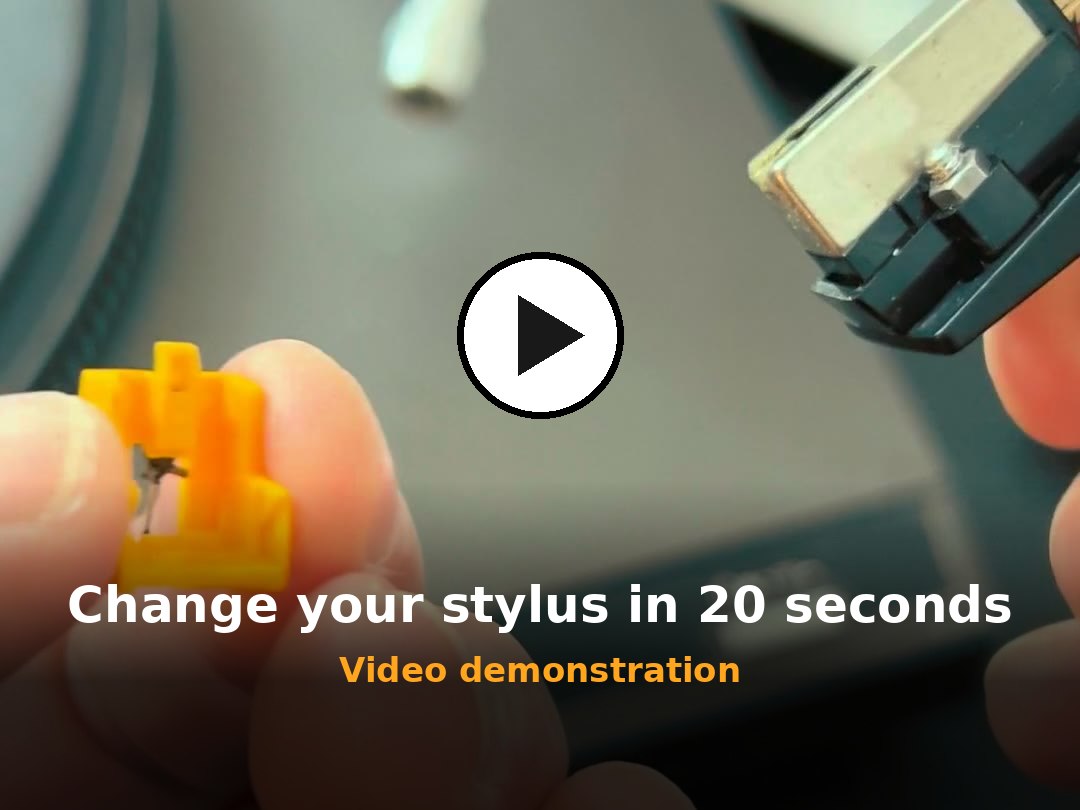
If it resists, do not lever it from underneath: check the removal direction in the manual or on the stylus page instead. Some models come out downwards, others pivot.
Step 4: fit the new stylus
Do the reverse: line the new stylus up with the cartridge, guard in place, then push it in until it stops. It should sit straight, without play, flush with the cartridge like the old one.
Remove the guard and look at the tip from the front and the side: the cantilever must be straight and centred. To go further, a 60x magnifier lets you check the tip and keep a reference of its new condition, as explained in our article on inspecting your stylus.
Step 5: check the tracking force
An aftermarket or upgraded stylus does not always have the same recommended tracking force as the original. It is the only setting to check after a replacement, and it matters for record wear as much as stylus wear.
- The recommended value is on the stylus page or packaging, in grams (for example 1.5 to 2 g).
- On a counterweight arm, set the counterweight to that value. The counterweight scale gives an indication; a stylus force gauge gives the real measurement.
- Set the anti-skating to the same value as the tracking force as a starting point.
- On a P-mount cartridge, there is nothing to adjust.
If you keep the same cartridge and the same stylus model, the existing settings normally still apply: a quick check is enough.
Common mistakes
- Ordering a stylus by turntable brand rather than by cartridge.
- Mixing up two close generations (one suffix can change everything, especially with Shure).
- Pulling on the arm instead of holding the headshell: you may knock the arm out of adjustment or bend the wires.
- Touching the tip with your fingers: it gets dirty, or the cantilever bends.
- Forgetting the tracking force after fitting a stylus from another range.
- Replacing the whole cartridge when a stylus was enough: it costs more and everything must be set up again.
Frequently asked questions
Do I need tools to change the stylus?
No, on an MM or ceramic cartridge the stylus plugs in by hand. A stylus force gauge is useful afterwards to check the tracking force.
How long does a stylus last?
It depends on the tip profile, the settings and the condition of your records: from a few hundred to over a thousand hours of listening. Signs of wear (veiled sound, sibilance, skipping) are covered in our turntable maintenance guide.
Can I fit a better stylus than the original?
Often yes, if it is designed for the same cartridge: for example an elliptical or hyperelliptical stylus instead of a spherical tip. Our guide Which stylus should you choose compares the options.
In short
- Read the reference of the cartridge, not the turntable.
- Find the matching stylus (its name often differs from the cartridge).
- Remove the old one while holding the headshell, forwards, without force.
- Push the new one in until it stops, straight.
- Check the tracking force and anti-skating.
Not sure about the reference? Browse our styli in the turntable parts section, or write to us with a photo of your cartridge: we advise by email, phone or video call, and can guide you through the fitting if needed.