The stylus is probably the smallest part of your hi-fi system. Yet it spends its evenings travelling through the record groove and turning microscopic movements into music. It deserves a little more attention than the occasional worried glance with the naked eye.
With a 60x illuminated microscope loupe for turntable styli, you can see the tip clearly and spot what an ordinary magnifying glass tends to leave in the fog: dust, fibres, residue, visible wear or damage.
Why should you inspect a turntable stylus?
A dirty stylus cannot follow the groove as accurately. The sound may become dull, distorted or unusually noisy. A damaged tip is more worrying because it may harm your records — and a rare pressing is not terribly enthusiastic about being used as diagnostic equipment.
A visual inspection is particularly useful:
- after buying a used turntable or vintage record player;
- when the history of the stylus is unknown;
- if the sound quality suddenly deteriorates;
- after the stylus has hit the platter or the edge of a record;
- before and after cleaning the tip.
What can you see with a 60x loupe?
The high magnification makes it possible to check for:
- dust, lint or residue gathered around the tip;
- a missing, chipped or visibly blunted stylus tip;
- a bent or off-centre cantilever;
- an obvious difference between a small microgroove stylus and a larger 78 rpm tip.
The loupe has two LED lighting options, allowing you to choose the clearest contrast for the surface being examined. Blue light is mainly included on this type of microscope for jewellery work, although it may help some particles or deposits stand out. For record-player use, the real star of the show is the 60x magnification.
Spherical, elliptical, Shibata… what are the main stylus profiles?
The profile is the shape given to the very end of the diamond. As the contact area becomes finer and more elongated, the stylus can follow smaller groove modulations more accurately. The trade-off is that advanced profiles demand more careful setup. Hi-fi can be rather like an old mechanical watch: wonderfully precise, provided everything is properly aligned.
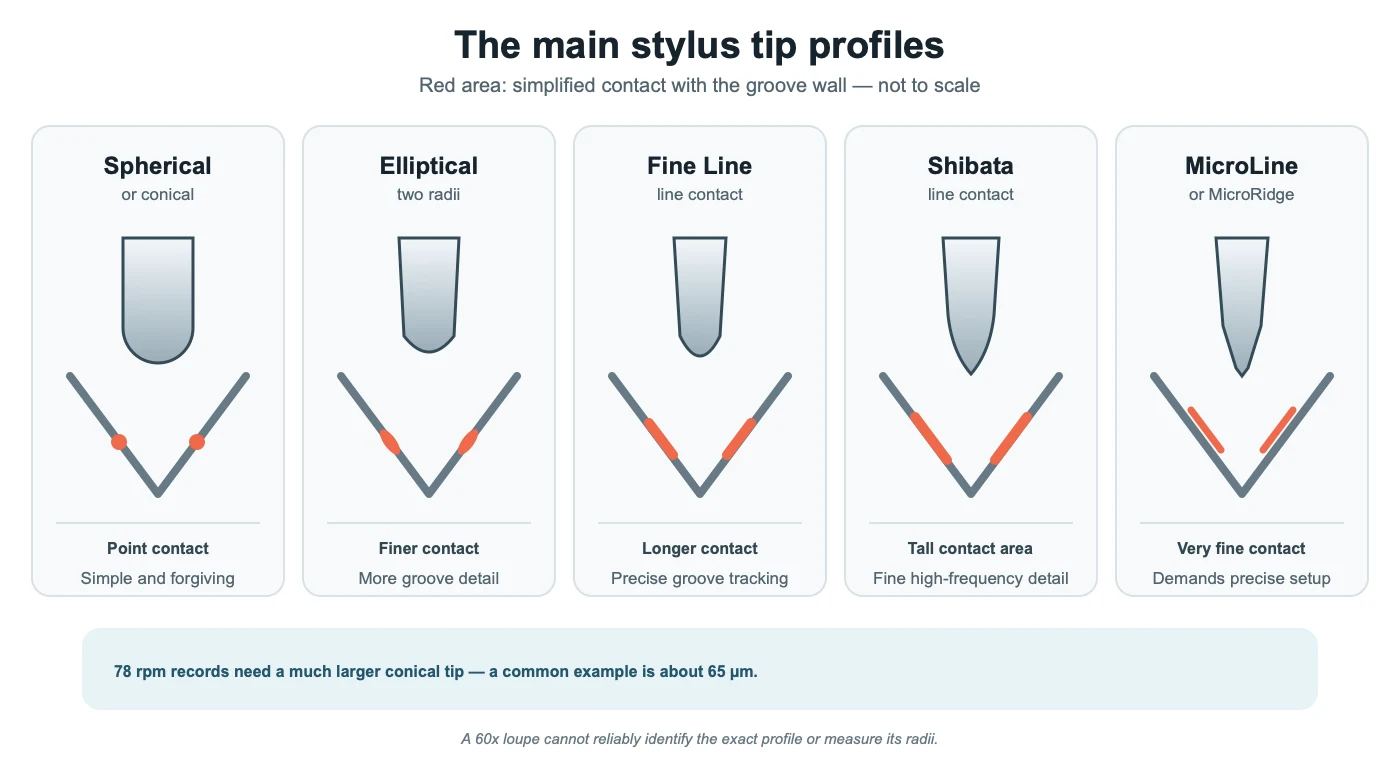
Simplified contact area of the main stylus profiles — drawing not to scale.
Spherical or conical stylus
This is the simplest rounded profile. It is robust, comparatively forgiving and well suited to everyday listening and many vintage machines. Its relatively small contact area, however, limits its ability to trace the finest details in the groove.
Elliptical stylus
An elliptical tip has two different radii and a narrower contact radius in the direction of travel. It follows the groove modulation more closely, retrieves more detail and can reduce inner-groove distortion when the cartridge is correctly aligned.
Fine Line or Line Contact stylus
This narrower and more elongated shape touches a greater vertical area of the groove wall. It can retrieve finer information and track with greater precision, but it is less forgiving of a poorly aligned cartridge.
Shibata stylus
The Shibata profile was originally developed to reproduce the high-frequency information carried by quadraphonic records. Its long contact area on the groove wall is valued for accurate tracking, fine detail and extended high-frequency reproduction.
MicroLine or MicroRidge stylus
This extremely fine profile is inspired by the shape of a record-cutting stylus. It can retrieve a great deal of information and trace difficult passages very accurately. It is an excellent design, but alignment, azimuth and tracking force must be set with care. At this level, “nearly straight” is no longer quite straight enough.
Good to know: elliptical, Shibata and MicroLine describe the shape of the tip. Bonded and nude describe how the diamond is constructed and mounted. These are different characteristics, and colour alone is not a reliable way to identify the stylus material through a loupe.
Can a 60x loupe identify the exact stylus profile?
You can see the tip, its general condition and some major differences, but you cannot reliably measure the minute radii that distinguish an elliptical, Shibata or MicroLine profile. That requires much more specialised inspection and measuring equipment.
The 60x loupe remains extremely useful because it quickly answers the important question: is the tip present, clean and visibly intact?
The special case of 78 rpm styli
Most 78 rpm records have a much wider groove than 33 and 45 rpm microgroove records. Their playback stylus is therefore much larger and generally spherical. A common example is approximately 65 µm, compared with roughly 15 to 18 µm for many spherical microgroove styli.
This size difference is often visible with a 60x loupe. It can help identify an unlabelled vintage stylus when its box and reference number have long since disappeared — a fairly normal state of affairs for record players that have survived several attics.
How to inspect the stylus safely
- Switch off the turntable and secure both the platter and tonearm.
- If the headshell or stylus can be removed easily, follow the manufacturer’s instructions. Otherwise, leave it in place.
- Turn on the loupe LED and bring the lens towards the tip slowly.
- Inspect the stylus from the front and from the side, using several angles.
- Never rest the loupe on the cantilever and do not touch the diamond.
- If you find a deposit, clean the stylus and inspect it again.

Six practical stylus-care tips
1. Clean records before playing them
A clean record leaves less dust on the tip. Use a suitable antistatic record brush before playback and store records in clean inner sleeves. The stylus does not collect dust as a hobby; it merely picks up what we put in its path.
2. Brush only from back to front
Use a proper stylus brush and always follow the cantilever direction, from the rear of the cartridge towards the stylus tip. Never brush backwards or from side to side. The cantilever is considerably more delicate than it looks.
3. Be careful with cleaning liquids and gels
Recommendations vary between manufacturers. Some advise using only a dry brush, while others permit a small quantity of an approved cleaning fluid. Follow the instructions supplied with your cartridge and never immerse the stylus. Alcohol or a homemade solvent may attack the adhesive or travel up the cantilever.
4. Never touch the tip with your fingers
Fingers leave grease behind, and one clumsy movement can bend the cantilever. Use the stylus guard when the turntable is not in use and secure the tonearm before moving the deck.
5. Check the cartridge setup
Use the tracking force recommended by the manufacturer and check alignment, azimuth and anti-skating. A tracking force that is too light is not necessarily gentler: a stylus that loses contact with the groove may bounce and damage the record.
6. Keep a rough record of playing hours
Stylus life varies with tip profile, cartridge setup, record cleanliness and use. Some manufacturers quote a few hundred hours for conical or elliptical styli and longer figures for certain MicroLine or Shibata designs. These figures are guidance, not a universal countdown clock. Listening, inspection and the cartridge manufacturer’s recommendations still matter.
When should the stylus be replaced?
Stop playing records and replace the stylus, or have it professionally checked, if you notice:
- a missing, broken or badly chipped tip;
- a bent or off-centre cantilever;
- persistent distortion despite a clean record and stylus;
- unusual sibilance or poor groove tracking;
- a completely unknown service history on a vintage machine.
A loupe reveals visible defects, but very fine wear may still escape it. When in doubt, it is better to sacrifice one stylus than an entire record collection.
A small loupe that answers some rather large questions
Compact, folding and supplied with a protective pouch, the 60x stylus microscope loupe provides a quick inspection without setting up a laboratory in the middle of the listening room. It requires three LR1130 button cells, which are included.
Whether you are checking a second-hand stylus, inspecting the result of a cleaning session or identifying a probable 78 rpm tip, it is a simple little tool that can be remarkably useful — and may save a few records from having a very bad afternoon.
Frequently asked questions
How can I tell whether a turntable stylus is worn?
A 60x loupe may reveal a broken, visibly blunted, misaligned or heavily contaminated tip. Persistent distortion, unusual sibilance and poor tracking are also warning signs. Very fine wear may still require professional inspection.
How should I clean a turntable stylus?
Use a suitable stylus brush and move it gently from the rear of the cartridge towards the tip. Never brush sideways or backwards. Before using any cleaning fluid, follow the cartridge manufacturer’s instructions.
Can a 60x loupe identify an elliptical stylus?
It can show the stylus tip and its overall condition, but it cannot reliably measure the extremely small radii that distinguish elliptical, Shibata and MicroLine profiles.
Can I play a 78 rpm record with a 33 or 45 rpm stylus?
It is not recommended. A 78 rpm groove is considerably wider and normally requires a much larger, usually spherical, stylus tip.
How often should I inspect the stylus?
Inspect it after an impact, whenever the sound changes, when buying used equipment and after cleaning. An occasional check also catches a deposit before it turns into a tiny felt hat under the cartridge.